Sequence work across two applications
One recording binds one surface. If the work starts in a browser intake form and finishes in a native posting app, record both.
for-each loops one bundle over a worklist. induce recovers a program from
several traces of the same task on the same backend. The two parents that
sequence work across surfaces are compose (compiled recordings) and
process (independently admitted capabilities).
Record one program per surface
Record and compile each application the way you already do:
openadapt flow record --backend web --url https://intake.example --out rec-intake
openadapt flow compile rec-intake --out intake-bundle --name intake

openadapt flow record --backend windows --out rec-posting
openadapt flow compile rec-posting --out posting-bundle --name posting
Decide the handoff before you sequence anything. The parent will copy
patient_id only if intake's effect contract already bound it. A window title
isn't that fact. Compose won't retarget the intake recording onto the
posting surface.
Sequence the recordings with compose
openadapt flow compose writes a parent directory of compiled children:
openadapt flow compose \
  --child intake=./intake-bundle \
  --child posting=./posting-bundle \
  --handoff intake.patient_id=posting.patient_id \
  --out composed
openadapt flow certify composed --policy clinical-write
openadapt flow run composed --config deploy.yaml
Default order is --child order. --after NAME=PRED declares a DAG; a cycle
is refused at authoring. Child B starts only after child A ends VERIFIED, or
a halt class you named with --allow-halt NAME=OUTCOME.
Handoffs copy parameter values that A's confirmed effect contract already bound. Missing evidence stops the run. The parent won't guess a URL.
The on-disk form is composed/composition.json (schema
openadapt.composition/v1) plus composed/children/<name>/. Subflows and
worklists stay inside each child. replay refuses this directory:
visualize on composed shows the child bundles, the handoff edges, and a
terminal labeled End of declared steps. Open intake-bundle if you need
intake's program graph.
openadapt flow visualize composed -o composed.html
openadapt flow visualize composed --format mermaid
openadapt flow visualize intake-bundle -o intake.html
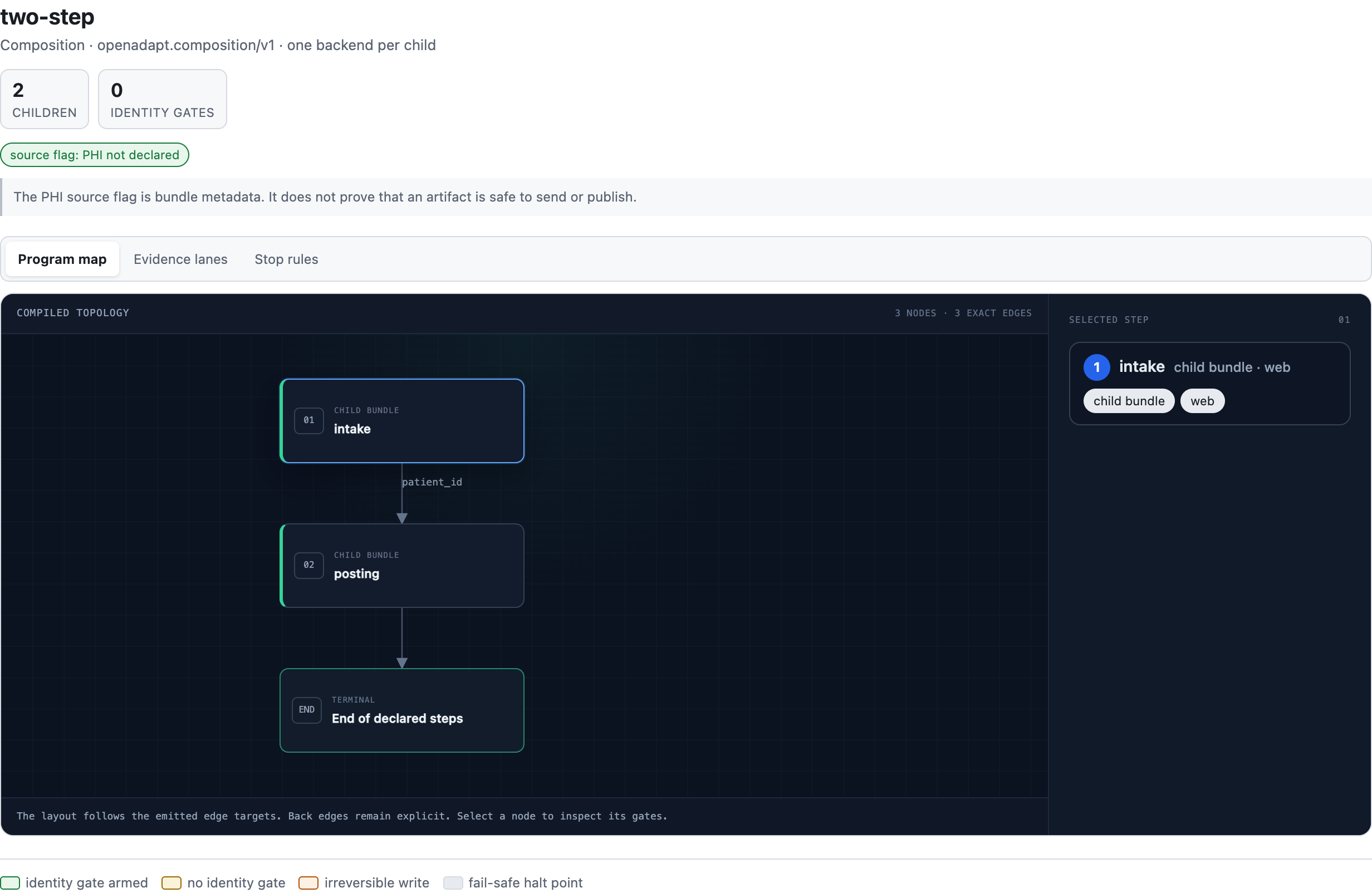
patient_id handoff, terminal End of declared steps. Representative synthetic composition.flowchart TD
n0(["intake<br/><small>web</small>"])
n1(["posting<br/><small>linux</small>"])
n2{{"End of declared steps"}}
n0 --> n1
n1 --> n2
n0 -->|patient_id| n1
classDef irreversible stroke:#b4530a,stroke-width:2px;
classDef halt stroke:#b21f2d,stroke-width:2px;Flags and the certify / run path are in the
CLI reference. See
Read a compiled program for the child
program map.
Qualify and admit each child
Compose sequences recordings. A ProcessContract parent will refuse those
copies. Qualify each child on its own surface, run
its counted campaign, and keep the signed
openadapt.qualification-admission/v1 envelope. The envelope's
admission_id is a UUID. It is distinct from runtime_validation_id.
A recording you compiled five minutes ago and forgot to qualify is not a process child.
Sequence admitted capabilities with process
After both envelopes exist, author the process parent:
openadapt flow process \
  --child intake=./intake-bundle \
  --admission intake=./intake-admission.json \
  --child posting=./posting-bundle \
  --admission posting=./posting-admission.json \
  --handoff intake.patient_id=posting.patient_id \
  --out process-parent
openadapt flow visualize process-parent -o process.html
--handoff, --after, and --allow-halt have the same shape as compose.
--child NAME=BUNDLE is the admitted bundle. --admission NAME=ENVELOPE is
that child's signed openadapt.qualification-admission/v1 file. A compose
child path under composition.json is not an envelope. The parent file is
process-parent/process-contract.json, schema
openadapt.process-contract/v0. It points at the envelopes. It doesn't copy
recordings. It doesn't become a ProgramGraph.
Pointing process at a composition.json directory is refused. That check is
what keeps unqualified recordings out of a process receipt.
Each child runs through OpenAdapt Execute
with that child's envelope, qualification binding, and its own idempotency
key. replay of the process parent is refused.
visualize on the process directory shows admitted children, handoff edges,
and End of declared steps. That label means the declared sequence ended. It
doesn't mean VERIFIED. Parent VERIFIED requires every child VERIFIED
and zero model calls.
flowchart TD
  intake["intake<br/>adm 11111111<br/>digest aaaaaaaa<br/>web"]
  posting["posting<br/>adm 77777777<br/>digest bbbbbbbb<br/>linux"]
  end_declared_steps["End of declared steps"]
  intake --> posting
  posting --> end_declared_steps
  intake -.->|patient_id| posting
  classDef admitted fill:#e8f0fe,stroke:#3b6ea5,color:#111;
  classDef terminal fill:#f3f4f6,stroke:#6b7280,color:#111;
  class intake,posting admitted;
  class end_declared_steps terminal;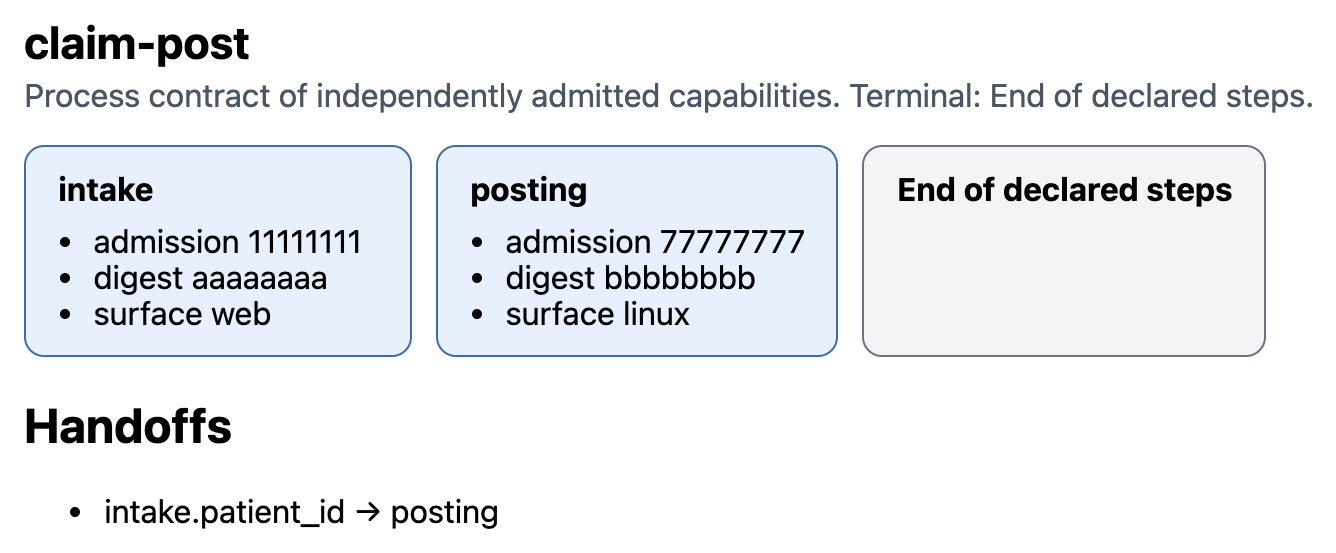
admission_id and digest values are fixtures.Open the child bundle when you need its steps. The parent view won't inline them.