Attended decisions and the halt-learn loop
A halt nobody hears is just a stopped run, and a halt that teaches the system nothing means the same unhandled state halts forever. This page covers both halves of the answer: where a halt goes (the bounded question OpenAdapt puts in front of a person) and what happens when that person teaches the fix, which is the halt-learn loop proper.
Neither half hands control to a free-form agent, and neither puts a generative-model API call on the runtime path.
Terms used here
- BYOC means bring your own cloud: a customer-owned cloud runner and storage boundary. It is one form of customer-controlled execution.
- An effect verifier independently reads the system of record to confirm a declared write. It does not treat a screen message as proof.
- Qualification is the versioned evidence that one exact workflow behaves correctly in its named application, environment, and execution surface.
- An identity gate checks the intended record before a consequential action and halts if it cannot verify that record.
- Reconciliation rechecks a possible or conflicting effect without re-dispatching the action.
See the full glossary for the shared terms and their contract boundaries.
Where a halt goes: the attended decision
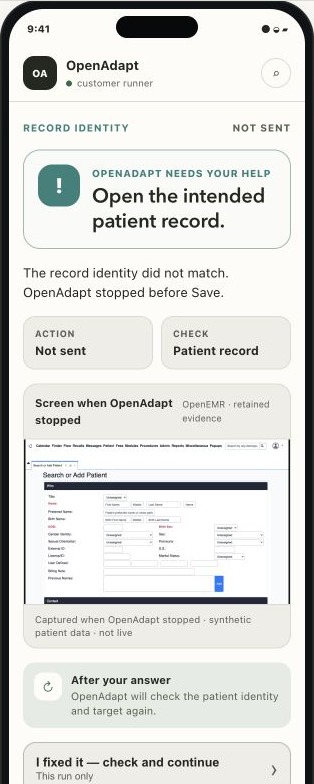
When a run cannot confirm something, it stops and projects the paused step into a bounded request. A member of staff can answer it at the runner, from the Cloud dashboard on a phone, or through a phone portal that the customer hosts.
The request states one of six reasons for attention: record identity, target ambiguity, a human-only step, saved-result verification, uncertain delivery, or a required halt. The runner offers only the actions that are safe for that request.
Operational decisions are bounded; business judgment stays human
An attended decision manages an operational halt. It can ask an authorized operator to prepare the live state, stop, skip an explicitly permitted step, escalate, teach a correction, or reconcile a possible effect. The signed task binds the exact run, pause, permitted actions, and revalidation requirements.
It does not ask OpenAdapt to make arbitrary business judgment. A workflow that
needs a business choice must use a reviewed typed decision contract with finite
options and a role requirement, or stop for a human to complete the action.
See Human judgment in a workflow. After either path, the
runner rechecks the live identity, state, and configured effect before it
reports VERIFIED or resumes.
The question is closed by construction. openadapt-flow projects the pause into
a signed task carrying typed categories, bounded counts, and digests; the client
owns every sentence a person reads. The runner never sends prose and the phone
never renders a runner string, so protected content has no field on the wire to
travel in. What the operator sees is composed locally: which step could not
start, what kind of target it was looking for, what the
resolution ladder tried on each rung, and what the
engine will re-prove if they continue.
The decision client is a responsive web app, not a native iOS or Android application, so there is no app store or separate update channel. The customer-controlled runner serves the full local portal. The hosted queue receives only a closed, PHI-free decision context.
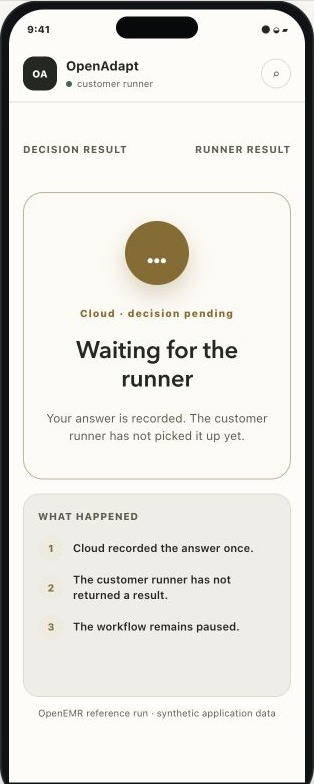
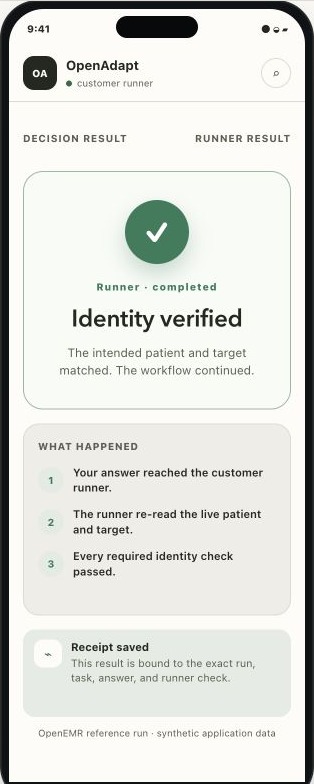
The three images below show the runner-local, full-evidence portal with synthetic OpenEMR data. The hosted lane uses the same signed actions and transition states, but it omits screenshots and protected fields.
The operator returns a decision, not an execution result
This is the property everything else rests on. Answering does not perform the step, and it does not mark the run verified.
When an answer arrives, the engine:
- validates the signed task digest, the exact pause capability, and the engine-derived allowed-action list;
- takes a single-flight lease, so two people cannot both decide one task;
- re-reads the live application and re-runs its identity, postcondition, and effect checks against a fresh observation;
- continues only if that fresh check passes, and refuses when the application is not actually in the state the step needs.
So "I fixed it" means I prepared the live state; now go and check it. It never
means "repeat the paused write". A run reaches VERIFIED only when the complete
configured contract proves the intended effect, exactly as on an unattended run.
An operator's answer is an input to a verification, never a substitute for one,
which is why an operator who is mistaken produces a second halt instead of a
silent wrong write.
The operator's own work is verified, not replayed
When the person completed the step themselves, OpenAdapt advances the resume point on the strength of outcome verification and records the step as a human-attended actuation. It does not actuate the application a second time. A step whose postconditions or independent effect check do not pass is refused, not banked.
The reply also keeps delivery states distinct. Three states stay distinct: not sent, sent, and may have been sent. For uncertain delivery, use Reconcile. The runner reads the required postcondition and independent effect again. It does not send the action again. It reports a reconciled result only when that check proves the effect; otherwise it stays halted for safe review.
Full evidence stays on the runner
The retained screen, the observed values, the OCR, and the failing target never leave the customer-controlled runner. Only a typed, PHI-free envelope crosses to a hosted control plane: opaque identifiers, digests, closed enums, bounded counts, and expiry. There is no free-text field anywhere in that envelope, so raw values and prose are structurally unable to travel; they are not stripped in transit.
The direct consequence is that a hosted surface shows less than the runner: it can say the shape of a failure but not its content. That is the design working, not a gap:
- "0 of 2 required identity signals confirmed the record on screen" is a bounded integer and crosses the boundary safely.
- "the OCR rung was tried and did not resolve a unique target" is a pair of closed enums and crosses safely too.
- "could not find the button labelled Open" names on-screen content, so it stays local.
A hosted surface that says less is a surface that cannot leak more. An operator who needs the full picture opens the run on the runner, where the evidence already is, and the hosted surface says so, so absent detail does not read as "OpenAdapt does not know".
Sending a decision back through a hosted control plane requires an explicit deployment opt-in bound to one tenant and one runner. It also requires the stronger authentication policy for remote issuance. The outbound runner lane, hosted mobile projection, and encrypted Web Push are deployed; an unconfigured runner keeps decisions on its local surface.
Reaching it from a phone
There are two ways, and they trade fidelity against what your network has to do. Neither of them asks OpenAdapt to open a hole in it.
The hosted lane: nothing to configure
This is the default answer for a practice without an IT department. The runner makes outbound HTTPS requests only to the control plane: no inbound port, no port forward, no certificate, no reverse proxy, no static address. It works behind NAT on an ordinary broadband line.
- Connect the desktop app to OpenAdapt Cloud once. It registers this computer and stores its credential in the operating-system keychain.
- Turn on remote decisions in your deployment configuration, bound to the exact tenant and runner the control plane issued.
- In Needs attention, scan the dashboard QR code. It opens the same-origin Cloud phone page, with no session or decision authority in the code. Sign in there, then select Notify this browser if you want Web Push alerts.
The hosted queue can send an encrypted Web Push notification when a signed task needs attention. The notification contains no application content. The opened queue shows only the closed halt context described below.
That is the whole list. You do not terminate TLS. The only TLS involved is the runner's outbound connection to a public host with an ordinary public certificate.
What the phone shows on this lane is the closed halt context: which category of check failed, which resolution rungs were tried and what each one returned, which contracts a "Continue" will re-prove, and bounded counts. Every value is a closed enum, a bounded integer, or a boolean. There is no string field and no image, so the hosted service is structurally unable to hold a name, an MRN, an observed value, or a workflow label. It is not scrubbed; it has nowhere to put them.
The one thing it gives up is the target control's own accessible name. The phone
says "OpenAdapt could not find the button" instead of "the button labelled
Open", and it tells you a name exists that it is not showing you.
The runner-local portal: full fidelity, on your own terms
The portal on the runner serves everything, including the protected screenshot crops. That is why it is the path with a network requirement.
The portal is loopback-only until you publish it
Out of the box the decision portal binds 127.0.0.1 and advertises a
loopback URL. A phone cannot reach it, and a fresh install will not serve
one. Publishing it to a phone requires you to terminate trusted TLS in
front of the runner (an enterprise reverse proxy, a VPN, or a ZTNA
hostname) and to record that decision in configuration.
Use the hosted lane above if you do not operate one. See the portal settings for the exact variables and Deploy on-prem for where it sits in a deployment.
We did not punch a hole in your network for our convenience, and there is no "bind everything" switch to make a demo easier. The boundary in front of a runner that can see protected records is yours to open, deliberately, under your own certificate and access policy, so this path inherits the authentication, device posture, and logging you already run, instead of asking you to trust a second one.
Every widening step is explicit and fails closed. A wildcard bind address is refused in every mode. So is a plaintext origin, an origin carrying a path or credentials, a hostname where a literal address is required, and a published mode missing either its public origin or its operator acknowledgement. Any invalid combination raises and the portal does not start; it never quietly widens its own exposure to become reachable. There is no self-signed-certificate bypass and no test-only wide bind.
Pairing a phone
Pairing runs the opposite way round from the obvious design, and the reversal is the point.
For the self-hosted portal, the runner shows a QR code. Scan it from the phone. The phone then shows a short, one-use pairing code. Type that code on the runner to approve that phone. This binds the phone to the local portal; it does not give the phone an engine or console capability.
Do it the intuitive way (derive the code from the pairing and show it on the runner) and an attacker who photographed the QR from across the room and claimed it first would be shown the very code the runner's screen was already displaying. The "matching code" would then confirm the attacker. Minting per claim means a remote attacker's phone shows a code the operator cannot see, and the mismatch is visible immediately.
The rest of the shape follows from the same posture:
- The QR link carries only a pairing secret: no console capability, no pause capability, no tenant, run, or pause identifier.
- The secret rides in the URL fragment, which browsers never transmit, so it cannot land in a reverse-proxy access log or a referrer header.
- It is claimable exactly once, atomically. A second phone scanning the same code is refused.
- It expires shortly after it is shown, enforced server-side and re-checked at approval, against both a monotonic and a wall clock so neither a suspended machine nor a clock change can extend the window.
- A claimed session is unusable until approved, attempts are bounded, and showing a new QR retires every earlier unapproved pairing so a stolen code cannot sit latent.
- Secrets and session tokens are stored only as digests and compared in constant time. Paired devices are listed and revocable, and sessions expire.
The phone never receives the engine's console capability. It holds a session token bound to that runner and that approved pairing, and nothing else.
One decision cannot become a second authority
The signed task makes the presented question tamper-evident. It does not itself grant execution authority. Before a remote answer can change a run, the runner binds it again to the exact tenant, runner, task revision, pause capability, allowed operation, expected transition, expiry, and idempotency scope. It then takes a single-flight lease and repeats the live checks. A replayed, expired, or mismatched answer is refused. The control plane can request a decision; the customer-controlled runner remains the final authority for execution.
What an operator can request
The runner selects from these actions for the current request. A phone cannot add an action that the signed task did not permit.
| Request | Result |
|---|---|
| Check and continue | The runner takes a fresh observation and resumes only when its checks pass. |
| Skip | The runner resumes only when the workflow explicitly permits a skip. |
| Stop this run | Ends this run without a further application action. |
| Teach the correction | Leaves this run paused and opens the local correction path. |
| Ask for help | Keeps the durable pause for an authorized colleague. |
| Reconcile | For a sent or uncertain action, proves the saved effect without re-dispatch. |
The receipt then reports one distinct outcome: verified and resumed, skipped and resumed, refused after revalidation, halted again, expired, demonstration requested, escalated, stopped by the operator, or reconciled and resumed. A recorded request is not a verified result.
Operating-system notifications for these are generic by construction: the runner reads a single count from a PHI-free endpoint and renders a fixed template. No upstream string is ever forwarded to a notification, on any channel.
"Teach the correction" is the front door to the rest of this page.
The learn loop
Answering a halt keeps one run moving. Teach starts from the latest saved, eligible HALTED run. Desktop records the correction, compiles a candidate, and reruns qualification. Only a promoted candidate affects future runs. Each future run still requires its own runtime evidence and can halt. A candidate is adopted only if it passes the qualification and safety gates.
flowchart TD
    H([Run halts on an<br/>unhandled state]) --> T[Halt emits a<br/>learnable execution trace]
    T --> D[Operator demonstrates<br/>the resolving actions]
    D --> I[Goverened induction:<br/>compile the fix as a<br/>guarded branch]
    I --> G{Regression gate +<br/>held-out canary}
    G -->|weakens identity / effect /<br/>risk, or underdetermined| Q([Quarantine:<br/>stays halting])
G -->|covers the new case,<br/>regresses nothing| P([Promote qualified<br/>candidate])- A halt emits a learnable trace. The run report records the halt point,
the unexpected on-screen text, and the completed pre-context as the same
ExecutionTracetype the learning loop already consumes. - The correction is a demonstration. The operator's resolving actions (dismiss the modal, then continue) extend the halt's pre-context, the shape a normal recording produces.
- Induce through the governed path. The demonstration feeds the same multi-trace induction machinery, which compiles the resolution as a guarded conditional branch on the workflow-program graph, not a special case bolted on.
- Gate, then canary. A candidate must pass a deterministic regression gate and a held-out canary before promotion.
- Promote or quarantine. Only a candidate that passes qualification and does not regress safety becomes active for future runs. If the correction underdetermines the generalization, the loop refuses to promote.
The regression gate: what a revision may not weaken
A learned revision may change how a step is performed (its locator, its rung) but never silently weaken what the workflow means. The gate traverses both programs (subflows included), matches consequential actions by structural role rather than raw step id, and quarantines any candidate that would:
- drop or weaken a reachable consequential/irreversible action, or make one reachable under more conditions than before;
- shrink the set of identity checks that must pass before a write;
- lose a system-of-record effect contract, or add a new consequential action without effects;
- downgrade a risk label (irreversible → reversible);
- drop an approval requirement on an action that needed operator confirmation.
Each quarantines the revision with a reason. Merely "covering more traces" does not pass if it costs any of the above.
Versioned, provenance-tracked skills
Promoted revisions live in a versioned skill library that keeps every revision's provenance and status, and never silently adopts an unverified one. A quarantined candidate is retained with its rejection reason; the active version is unchanged.
Driving it: openadapt flow teach
The whole demonstrate-and-promote flow runs from one command. Point teach at
the halted run directory (holding report.json with a halt), give it the fix
demonstration and the base bundle that halted, and name where a promoted bundle
should be written:
openadapt flow teach runs/replay-20260712-140233 \
    --fix recordings/dismiss-the-dialog \
    --bundle bundles/patient-intake \
    --out bundles/patient-intake-v2
| Flag | Description |
|---|---|
run_dir (positional) |
The HALTED run directory (holds report.json with a halt) |
--fix (required) |
The fix demonstration: a recording directory of just the corrective actions (e.g. dismiss the dialog), or a .json correction spec (scripted / CI: resolution_steps, optional tail_intents / facts / params) |
--bundle (required) |
The base bundle that halted (seeds the skill's active version) |
--out (required) |
Output directory for the UPDATED bundle, written only when the correction is promoted |
--skill-id |
Skill id in the versioned library (default: the run's workflow name) |
--library |
Directory for the versioned skill library that keeps the promotion lineage (default: <out>.skills) |
teach runs the governed loop end to end (load the halt, turn the fix into the
operator-correction trace, induce, regression-gate, held-out canary) and writes
--out only if the revision is promoted. On the shipped path it is
deterministic and makes no generative-model API calls ($0 in model API
charges): the resolution is induced by the model-free reference inducer (the
structural-diff inducer that handles the "an unexpected optional dialog
intercepted the workflow" class the loop was built for). A model-backed inducer
wires in behind the same Inducer seam without touching this flow.
The refusal path is a normal outcome, not an error. If the single correction
underdetermines the generalization, or the induced revision would weaken a
safety invariant, the loop refuses to promote: nothing is written to --out,
the base bundle stays halting, and the command exits nonzero (1) with the
reason. Unusable inputs (no halt in the report, no base bundle, a malformed fix)
are a distinct failure and exit 2. A successful promotion exits 0 and prints
the re-run command.
What is proven, and what depends on the inducer
The loop's governance (the regression gate, the held-out canary, the
versioned skill library, the halt→demonstration bridge) is proven
independently of any induction implementation: the inducer is injected
behind an Inducer seam and a deterministic reference inducer exercises the
loop in tests. The reference inducer covers the optional-dialog resolution
class; generalizing to arbitrary corrections is the job of a richer inducer
behind that same seam, which inherits the same gate.
What a person supplies, what the engine keeps
The only thing trusted to generalize a fix is a demonstration plus a gate. A revision that might weaken safety is quarantined, not shipped. That pairs with multi-trace induction (recover the program from several traces) and policy and certify (refuse a bundle whose gaps were not closed).
It would be easier to treat a tap as an answer, publish the portal on every interface so a phone just works, and forward the failing screen to a dashboard where support can see it. Each of those would move a decision, a network boundary, or a protected record somewhere it does not belong. The person supplies the one thing a machine cannot (an observation about the world) and the engine keeps the rest: re-reading live state, checking identity and effects, and refusing. A halt reaches a phone in seconds, and it still cannot turn into a wrong write because somebody was in a hurry.