OpenAdapt Hosted
OpenAdapt Hosted is the managed control plane for governed workflows. The public $29/month subscription covers approved browser workflows and adds account and organization management, managed execution of locally authored and attested bundles, artifact storage, structural run history, usage metering, and billing. The same compiler and governed runtime remain available under MIT for local and customer-controlled deployments.
Governed authoring, validation, and repair remain local. The hosted recorder is available for explicitly initiated public, non-regulated browser sessions; use local recording and a reviewed sanitized derivative when source observations cannot enter the OpenAdapt-hosted boundary.
Start with OpenAdapt Review the data boundary
Payment runs through Stripe, and the price shown on the website is the exact price you pay at Checkout.
Manage account security and privileged access, including authenticator setup, step-up verification, recovery codes, organization switching, and sign-out.
What the subscription includes
| Surface | Availability | Boundary |
|---|---|---|
| Local browser record -> compile -> managed execute | Included in the managed subscription | Governed authoring and validation remain local; managed execution uses the qualified browser substrate. |
| Hosted browser record -> compileable workflow | Available for approved sessions | The retained non-simulated provider qualification used openadapt-flow 1.8.0. As of 2026-10-14, the managed-runtime manifest pins Flow 1.34.0 artifact identity; the deployment matrix lists its hashes. A runtime pin does not prove live deployment or hosted workflow acceptance. This is a separate raw-observation boundary, not the reviewed-derivative upload lane. |
| Account, organization, onboarding | Included in the managed subscription | Checkout and sign-in bind the subscription to an isolated organization. |
| Structural run history and reports | Included in the managed subscription | Safety depends on the workflow's configured identity, effect, and policy checks. Repair and validation remain local. |
| Checkout, portal, entitlements, metering | Included in the managed subscription | Live Stripe Checkout, signed webhooks, entitlements, usage, and the billing portal form one managed subscription contract. |
| Self-hosted browser execution | Available locally | No hosted account required. |
| Windows UIA | Supported / scoped deployment | The exact in-tree WinForms matrix passed 3/3 with an independent SQLite oracle and 3/3 stale/ambiguity refusals. Windows subscriptions and deployments are ordered separately from the public browser offer and qualified per workflow. |
| Native macOS | Supported / scoped deployment | One macOS 15.7.3 arm64 host produced 3/3 exact-byte TextEdit effects plus a two-window ambiguity refusal. Native macOS subscriptions and deployments are ordered separately from the public browser offer and qualified per workflow. |
| Native Linux | Supported / scoped deployment | The required Ubuntu 24.04 X11/AT-SPI current-main lane completed 3/3 exact-file effects and refused 3/3 ambiguous plus 3/3 stale targets, with zero silent incorrect successes, over-halts, interventions, or model calls. Native Linux deployments run locally or in a customer-controlled boundary and are qualified per workflow. |
| RDP | Supported / scoped deployment | Complementary accepted evidence covers 3/3 Aardwolf-over-Windows guest-file effects with independent guest-tools readback and a separate full record -> compile -> governed replay/refusal lifecycle over a real FreeRDP round trip. Consequential actions use a fresh-frame target/identity recheck and one-shot input lease that refuses changed session context. These are two bounded evidence records, not one combined Windows application claim. RDP subscriptions and deployments are ordered separately from the public browser offer and qualified per workflow. |
| Citrix / VDI | Supported / scoped deployment | The dedicated Citrix Workspace-window backend binds an exact owner/title, requires current-frame readiness for governed execution, and uses the shared pixel identity, effect, policy, halt, durable-resume, and two-phase remote-actuation contracts. Its retained no-DOM stand-in completed 3/3 healthy effects and 3/3 severe-drift safe-halts with zero silent incorrect successes, false completions, healthy over-halts, drift writes, or model calls. The artifact records code_readiness_accepted: true and ica_hdx_accepted: false; a counted real ICA/HDX client/codec/latency/DPI matrix remains an exact-deployment evidence boundary, not part of the public managed-browser subscription. |
| Regulated runtime data | Customer-controlled boundary | Use a scoped BYOC/on-prem deployment when live screens necessarily contain PHI/PII. |
The public subscription covers approved browser workflows. Windows, native macOS, native Linux, RDP, Citrix, regulated customer-controlled execution, professional services, support commitments, and assurance terms are scoped separately. See qualification evidence for the exact accepted substrate results; configured commercial terms define entitlement and support.
Hosted recorder boundary
The hosted recorder is a real, bounded authoring path, not a simulated
demo. A qualified hosted browser session produced PNG frames, accepted and
retained input evidence, assembled a native recording, created one compileable
workflow idempotently, enforced its resource limits, and removed the ephemeral
qualification data. That retained qualification used an openadapt-flow 1.8.0
worker. As of 2026-10-14, the managed-runtime manifest pins the Flow 1.34.0
artifact identity. A pin does not prove that the build is live or that a
hosted workflow passed acceptance. The public readiness endpoint separately
verifies the configured live dependencies, including authentication, storage, runner, compiler,
runtime-validation trust, runtime boundary, bundle protection, recorder,
callbacks, scheduling, human-decision Web Push, retention, security events,
secret encryption, validation policy, and billing. Readiness is dependency
evidence, not a customer workflow qualification or an SLA.
The recorder accepts only public HTTPS DNS hosts and refuses credentials in the start URL, literal IP addresses, private or mixed DNS answers, and private network targets. Input is bounded, idempotent, and encrypted in the provider queue; completed recordings use private object storage and audited, short-lived download links. One active recorder is admitted per organization, with time, event-count, and archive-size limits.
Raw frames and events in this path are not sanitized. Use it only when those observations are allowed inside the declared OpenAdapt-hosted boundary. Do not enter PHI, PII, private-network credentials, or other regulated data. For data that cannot enter that boundary, record locally and use the reviewed-derivative protocol below, or keep execution inside a qualified customer-controlled boundary.
The hosted lifecycle
The hosted lifecycle is:
- Complete its qualified Stripe Checkout.
- Sign in with the checkout email and create or join an organization.
- Record a browser workflow locally or prepare an existing local recording.
- Sanitize, review, approve, and push the recording derivative. This registers the exact approved recording; it does not create a runnable workflow.
- Compile that approved recording locally. Run strict lint, policy certification, and a successful governed replay in a named non-PHI validation environment.
- Sanitize, review, and approve the compiled bundle. Bundle sanitation must preserve execution-bearing content.
- Run
validate-hosted. It requests an expiring, one-time organization/token challenge and creates an operator attestation bound to the exact approved recording, bundle, compiler provenance, policy, risk class, and replay report. - Immediately push the approved bundle with that attestation. Cloud consumes the challenge and admits the bundle only if policy and risk-class allowlists also pass.
- Configure the vault secret-set reference and optional schedule. The target URL, allowed hosts, and parameter schema are immutable attested bundle properties; supply non-secret parameter values for each run.
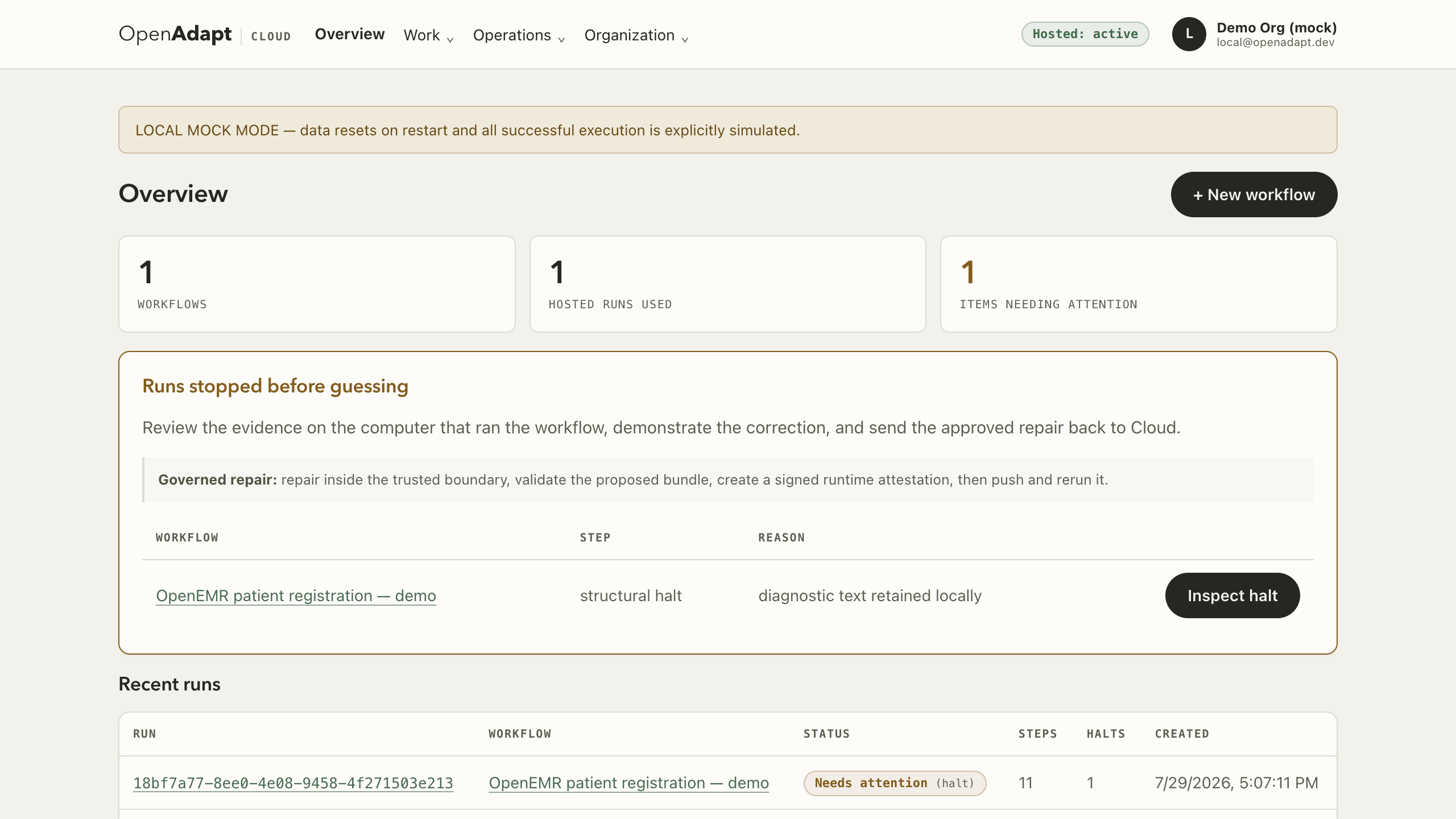
- Teach or repair a halted run locally, revalidate it, and activate the attested replacement on the same workflow; promote only a revision that passes its gates.
- Inspect usage and manage the subscription through the billing portal.
Checkout does not relax a safety or egress refusal. A paid organization cannot upload an unapproved artifact or execute a workflow that fails its configured run gate.
Exact local-to-hosted sequence
The example below uses the consequential clinical-write lane. Choose the
policy required by the deployment. --risk-class is not a free-form assertion:
the client derives low or consequential from the compiled steps and refuses
a mismatch. Cloud may further restrict both values with its exact deployment
allowlists.
# 1. Approve and register the exact recording derivative.
openadapt flow sanitize recording --kind recording --out recording.sanitized
openadapt flow review-sanitized recording.sanitized --original recording
openadapt flow approve-sanitized recording.sanitized \
  --original recording --reviewer alice@example.com
openadapt flow push recording.sanitized --kind recording --name "Triage"

# 2. Compile and validate locally from that approved derivative.
openadapt flow compile recording.sanitized --out bundle --name triage
openadapt flow lint bundle --strict
openadapt flow certify bundle --policy clinical-write
openadapt flow replay bundle --url https://validation.example/login \
  --run-dir runs/triage-validation --param patient_id=synthetic-001

# 3. Approve the exact runnable bundle derivative.
openadapt flow sanitize bundle --kind bundle --out bundle.sanitized
openadapt flow review-sanitized bundle.sanitized --original bundle
openadapt flow approve-sanitized bundle.sanitized \
  --original bundle --reviewer alice@example.com

# 4. Acquire the one-time challenge and bind the local evidence to it.
openadapt flow validate-hosted \
  --recording recording.sanitized \
  --bundle bundle.sanitized \
  --run-dir runs/triage-validation \
  --policy clinical-write \
  --risk-class consequential \
  --environment validation/mock-emr-v1 \
  --target-url https://validation.example/login \
  --out triage.runtime-validation.json

# 5. Consume the challenge by uploading the exact attested bundle once.
openadapt flow push bundle.sanitized --kind bundle --name "Triage" \
  --validation-attestation triage.runtime-validation.json
For a repair, generate a fresh attestation and activate the reviewed replacement on the same workflow while binding it to the halted run:
openadapt flow push bundle.repaired.sanitized --kind bundle \
  --workflow-id <workflow-uuid> \
  --resolves-run-id <halted-run-uuid> \
  --validation-attestation triage.repaired.runtime-validation.json
The control plane refuses a run from another tenant or workflow, locks the unresolved halt, activates the validated version atomically, and only then marks that halt resolved. Reusing an already accepted archive cannot resolve a new halt.
Do not edit either derivative after approval, rerun after generating the attestation, or reuse the attestation for another upload. Any changed archive hash, provenance link, parameter schema, report, policy, risk class, token, or challenge is refused. The attestation supplies the immutable target origin, host allowlist, and parameter schema. After bundle ingest succeeds, select the vault secret-set reference and optional schedule; provide non-secret parameter values only in the Run now dialog. Runtime values are forwarded to that run and are not persisted in bundle metadata. The hosted run is a separate execution and remains subject to its runtime, entitlement, and data-boundary gates.
What “scrubbed” means
Compilation does not make a recording or bundle PHI/PII-free. Scrubbing is a separate local derivation protocol:
The sanitized derivative is admitted by its manifest-bound cryptographic derivative hash.
- Inventory every input. Enumerate files, metadata, and channels. A symlink, archive, database, image, media file, or unknown type requires an explicit handler.
- Transform a copy. Preserve the sensitive original locally. Redact or parameterize supported text, structured records, screenshots, and metadata into a separate derivative.
- Rescan. Run the detectors over the derivative, not only the source.
- Write a manifest. Record policy and tool versions, transformations, unresolved findings, artifact inventory, and a cryptographic derivative hash.
- Review when required. A local viewer lets an authorized operator inspect the sanitized result, correct missed or excessive redactions, and approve the exact hash.
- Upload the approved bytes. Any later modification changes the hash and invalidates approval. Unknown or unresolved content is refused rather than copied through.
The original and derivative have different purposes. Keep the original inside its trusted boundary for authoring and replay evidence; share only the approved derivative.
Sanitation and runnability are separate gates. Redacting a selector, literal,
target label, identity field, or other execution-bearing value can make a
recording safe to transfer but unable to compile or replay correctly. Hosted
ingest labels that case needs_parameterization. Parameterize and compile the
approved recording locally, validate the bindings and replay, then sanitize and
approve a bundle whose execution-bearing content remains unchanged. Privacy
approval alone never promotes a recording or bundle to runnable status.
What the runtime attestation proves
validate-hosted recomputes strict lint and certification and reads a
successful, non-halted report.json. It refuses unless the evidence forms one
chain:
- the bundle provenance names the exact approved recording archive SHA-256;
- compiler name/version and compiler-configuration SHA-256 are sealed;
- the run report matches the workflow name, bundle content digest, source recording SHA-256, and parameter-schema SHA-256;
- hashes bind the strict-lint result, certification result, report bytes, and non-PHI validation-environment identifier;
- the supplied
loworconsequentialrisk class matches the compiled steps; - the approved bundle archive SHA-256 is the archive uploaded with the attestation.
The client signs this envelope with the ingest token. Cloud verifies the HMAC, fresh timestamp, exact bundle hash, configured policy, risk-class, and deployed compiler-version allowlists, and the challenge's organization, token, nonce, expiry, and unused state. The challenge expires after 15 minutes and is consumed transactionally by the accepted bundle upload.
This is operator self-attestation, not independent certification. It proves
that the token holder produced a tamper-evident envelope over the named local
evidence; Cloud did not observe the local replay and the HMAC is not an auditor
signature. certify means only that the bundle passed the selected policy.
Independent certification would require a separately controlled evaluator,
test environment, evidence custody, and signing identity. Neither mechanism is
a blanket safety, compliance, or correctness guarantee.
Review policy options
| Policy | Appropriate use | Tradeoff |
|---|---|---|
| Automatic after scrub | Narrow, schema-minimized diagnostics with complete type coverage. | Lowest friction; detector false negatives remain possible. |
| Human review required | Recordings, screenshots, free text, and consequential bundles. | Adds context but costs operator time; approval is not proof. |
| Risk-based hybrid | Automatic diagnostics, reviewed artifacts, administrator exception for measured pipelines. | Recommended default; requires explicit policy and audit configuration. |
Human review is local. The viewer must not send originals to a remote renderer, load remote resources, or cache the sensitive source outside the execution boundary. Approval records the reviewer, time, policy, manifest, and derivative hash.
This approval is operator attestation, not an independently witnessed review. Cloud accounts for the archive structure and verifies exact manifest/hash bindings, but it does not rerun OCR/NER or observe the loopback viewer. A regulated deployment must control reviewer identity and separation of duties; human approval reduces detector risk but is not proof of de-identification. Managed Cloud requires human approval by default. Automatic approval is a deployment-level capability that an operator must explicitly enable after reviewing the sanitizer policy; an uploader cannot opt itself into that mode. When enabled, automatic approval must carry an HMAC from a key ID in the deployment-controlled sanitizer allowlist. The signature covers the exact derivative and approval contract, so the ingest token alone cannot assert that the automatic policy ran.
Sanitized authoring data is not sanitized runtime data
A recording can replace a patient name with a parameter, while the live EMR screen still displays that patient's name during execution. Runtime frames, OCR, accessibility text, model inputs, reports, and effect evidence can therefore reintroduce PHI/PII.
Use these rules:
- Sanitized authoring derivatives may cross a destination permitted by policy.
- Runtime values are injected separately and are not written back into the sanitized authoring derivative.
- PHI/PII-bearing runtime observations remain inside the declared trusted execution boundary.
- A remote model is a separate destination and must be approved explicitly; healthy replay does not need one.
- If sanitization changes target identity or replay semantics, expect
needs_parameterization: parameterize, compile, and validate locally, then sanitize and approve the unchanged runnable bundle and completevalidate-hosted. Otherwise keep the workflow inside the trusted boundary. Do not call a non-functional derivative runnable.
Destination-aware decisions
| Transfer | Default decision |
|---|---|
| Local process -> local storage | Allow under local retention and encryption policy. |
| Approved derivative -> OpenAdapt Hosted | Allow when the manifest, review policy, destination, and hash pass. |
| Approved derivative -> verified customer endpoint | Allow under that customer's destination policy. |
| Raw or unresolved artifact -> any remote endpoint | Refuse. |
| Explicit hosted-recorder observations -> hosted recording boundary | Allow only for an entitled, public-HTTPS, non-regulated session that the user starts deliberately. |
| PHI/PII-bearing runtime observation -> shared managed boundary | Refuse unless that exact regulated service and legal boundary are configured. |
| Minimized break descriptor -> control plane | Allow after schema validation and sanitation. |
| Unknown destination | Refuse. |
BYOC is not synonymous with “deny.” A verified customer-owned endpoint may be a valid destination for data that its policy permits. Conversely, an OpenAdapt- managed endpoint is not valid merely because the user has a subscription.
Production mode versus mock mode
Mock mode is a development tool that returns synthetic users, workflows, and run results. Live mode uses real authentication, database, object storage, runner, and billing services.
A production deployment must explicitly select live mode and pass dependency health checks. If a runner or billing dependency is missing, the affected operation reports unavailable; it must not return a simulated success. This is what “production fails closed instead of silently using mock mode” means. It protects customers from believing a fabricated development run actually executed; it does not disable production functionality.
Retention, deletion, and restore evidence
The hosted service applies a versioned retention policy to recordings, reports, run metadata, and the declared recovery window. Legal holds pause eligible deletion. Tenant erasure is scoped to one organization and produces an append-only receipt containing resource identifiers, counts, and digests rather than deleted payloads.
Scheduled destructive retention is separately gated on a recent complete scratch-restore receipt. The operator path exports roles, schema, data, and every private Storage object; reads the source twice; restores only to an explicitly confirmed scratch project; and verifies exact hashes before recording the receipt. Production currently has no qualifying provider recovery point or complete scratch-restore receipt, so scheduled deletion remains gated. This does not claim provider PITR, object-storage recovery, or a backup SLA. The live readiness endpoint exposes retention configuration independently from that destructive-operation gate.
Production control checklist
Before directing traffic to a production deployment, verify:
- authentication and organization isolation;
- database migrations and row-level access controls;
- object storage and signed artifact access;
- hosted recorder URL controls, input sealing/idempotency, resource limits, private recording handoff, and finalization reconciliation;
- live runner enqueue, callback authentication, timeout, retry, and recovery;
- secrets exchange without values in browser or enqueue payloads;
- sanitation, local review, destination policy, and approval-hash enforcement;
- one-time validation challenge consumption, exact attestation bindings, and policy/risk-class allowlist enforcement;
- exact runtime-boundary ID/hash agreement across local attestation, workflow activation, control-plane configuration, job payload, and runner health;
- request-bound idempotency, one active run per workflow, and a lost provider acknowledgement that remains single-flight until callback or operator review;
- Stripe Checkout, portal, signed idempotent webhooks, entitlements, and usage;
- logs, alerts, legal holds, tenant erasure, deletion receipts, complete database + object-storage scratch restore, update, and rollback;
- a clean-account sign-up -> subscribe -> record sanitize/review/approve ->
recording push -> local compile/lint/certify/replay -> bundle
sanitize/review/approve ->
validate-hosted-> attested bundle push -> configure -> run -> report -> teach -> rerun -> bill lifecycle.
See the security review for the evidence an enterprise reviewer should request.