The Seal
A Seal is a signed attestation that this program version, this identity, this
environment, and this independent effect produced a terminal outcome. The
portable object is ExecuteEvidenceReceiptV1. Execute issues it. Execute is
the invoke path, not a separate product.
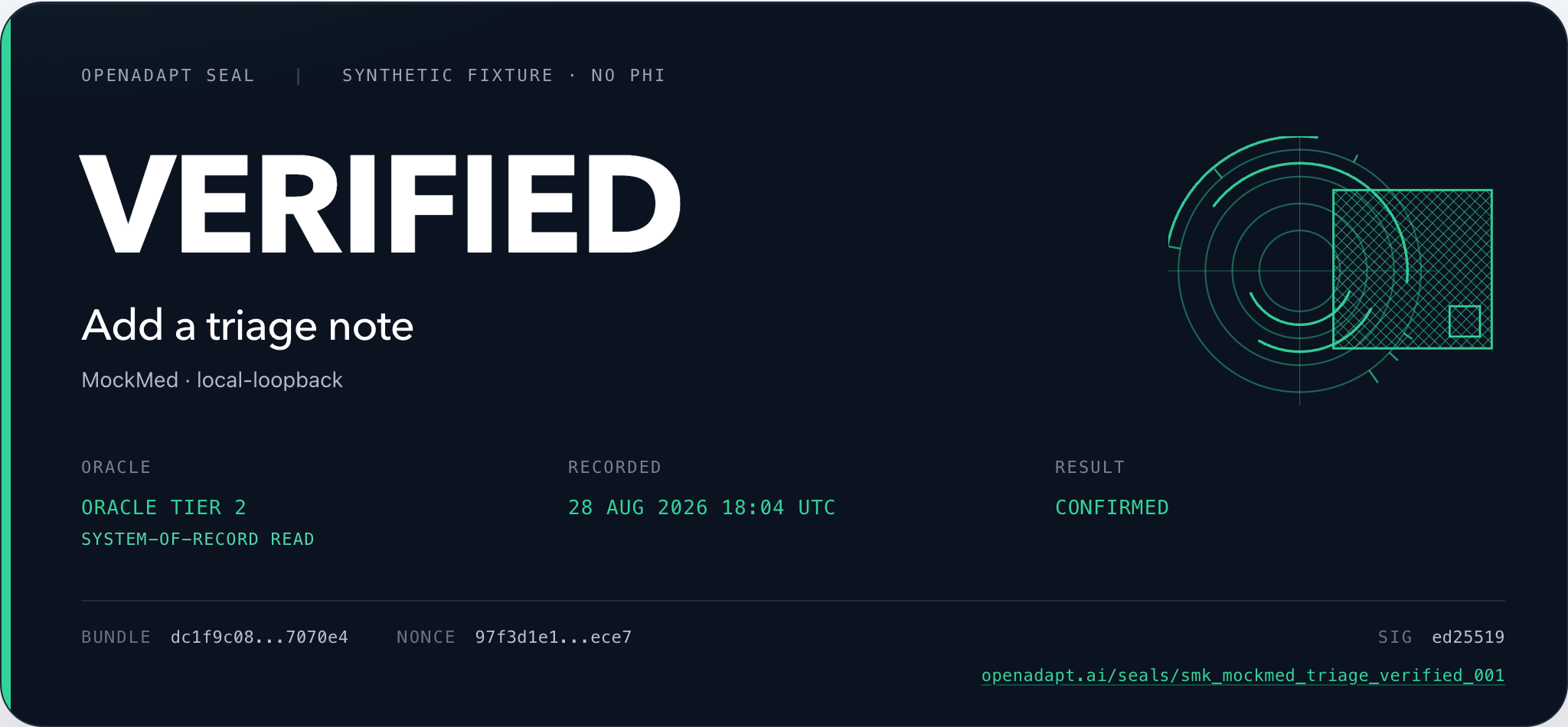
A VERIFIED Seal, desktop.
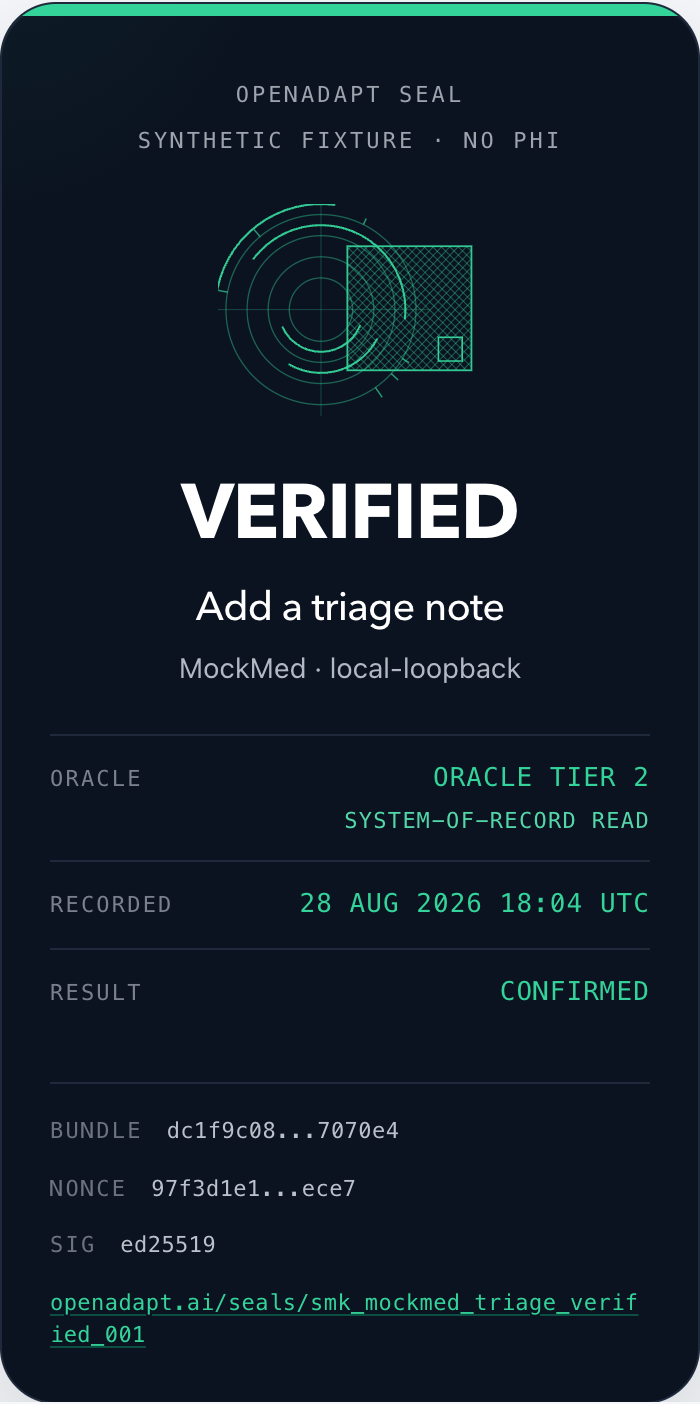
The same instrument, mobile.
POST /api/v1/executions is the partner invoke. The terminal receipt is the
Seal. Local unsigned openadapt-flow replay stays free. Unsigned success is
failure: if a consequential tool returns done without a Seal, treat the call as
failed.
The compiler stays MIT. Record, compile, replay, halt, teach, openadapt-types,
local MCP, and Agent Skills stay inspectable.
Public verify pages list synthetic and non-PHI Seals. They do not list healthcare production. Bundles are bound to one app build, one farm, one resolution, one custom screen.
Oracle tiers
Only a tier 2 or tier 3 oracle mints a production Seal.
| Tier | What it reads | Production Seal |
|---|---|---|
| 0 | Visual / OCR of the same screen that acted | Never. Dev only. |
| 1 | Second session or independent UI read | Never. |
| 2 | System-of-record read (API, database, file, ack) | Yes. |
| 3 | Counterparty artifact (payer status, legal export) | Yes. |
oracle_tier on the receipt must match contracts.observed_effect_strength.
independent_system_of_record maps to 2. independent_session maps to 1.
Screen confirmation and persisted-state reacquisition map to 0. Tier 3 has no
EffectStrengthV1 member yet; it is a stronger independent artifact, not a
banner on the acting screen.
openadapt flow tutorial --break-it (or openadapt quickstart --break-it) is
the fail-closed demo. A fake success banner must halt, and the store must stay
unchanged. During qualification, qualify propose and qualify accept run the
proposed oracle against the same kind of fault on their own. An oracle that
doesn't catch it can't be accepted.
A Seal that points at a screenshot hash is a liability. Do not mint production
verified below tier 2.
Attended and unattended operation
Attended is the mode available now. A person is already signed in to the
target application and the runner acts inside that session. When the runner
can't prove a required condition, the run pauses at decision_required. The
operator answers from the local console or the authenticated phone surface.
The runner then reacquires focus, a fresh observation, identity, and the
target before it continues.
In early access, a person reviews every entry before it is saved. That's how we run early-access work today; the runtime doesn't enforce it yet.
That person stays the legal actor. A Seal is not a physician signature.
Unattended operation needs a dedicated agent identity, privileged access management, and session recording, and it is qualified separately. In either mode, OpenAdapt does not type a person's password, reuse a person's login, or share a service account.
CLI story
On a qualified synthetic bundle with a tier-2 oracle, the intended command is:
A sealed verified run prints VERIFIED, a seal id, and the public verify URL:
--seal on replay issues that proof. openadapt flow seal encrypts a bundle
for deployment.
The same verb is available as openadapt flow replay bundle --seal. Use the
standalone openadapt-flow form when you installed the engine package.
The verify route is https://openadapt.ai/seals/{id}. Synthetic fixtures only
on that page.
Receipt fields are Seal fields
ExecuteEvidenceReceiptV1 is the Seal. Map the receipt 1:1.
| Receipt field | Seal field | What it binds |
|---|---|---|
receipt_id |
Seal id | Public verify at https://openadapt.ai/seals/{receipt_id} |
execution_id |
execution | The POST /v1/executions that produced this Seal |
workflow_digest |
program digest | SHA-256 of the admitted compiled program |
workflow_version |
program version | Qualified version id |
qualification_id |
admission | The qualification pack that authorized the run |
environment_id |
environment | The qualified environment |
runner_id |
runner | The customer-controlled runner |
nonce |
nonce | Per-Seal uniqueness so a consumer does not need the original request |
oracle_tier |
oracle | 0 visual, 1 second-session, 2 system of record, 3 counterparty |
outcome |
outcome | verified, halted_before_effect, reconciliation_required, rejected_policy, failed_platform, or rolled_back_verified |
contracts |
contracts | Authorization, identity, postcondition, effect, required and observed strength, model_used, external_network_used |
delivery_uncertain |
delivery | True when a write may have landed |
compensation_effect_verified |
compensation | True only for rolled_back_verified |
evidence_digest |
evidence | Pointer to retained evidence. Bytes stay in the declared boundary. |
issued_at |
issued | When the Seal was issued |
schema_version |
schema | Always openadapt.execute-evidence-receipt/v1 |
verified requires every contract, an observed strength at or above the
minimum, and oracle_tier 2 or 3. Store the full object with the partner
transaction. HTTP 202 is not a Seal.
requires_seal
Consequential MCP tools advertise requires_seal: true. Skill text: if the
tool returns unsigned success, treat it as failure.
Emit a local MCP server with openadapt flow emit-mcp bundle --out server.py.
The partner still validates the Seal the same way: receipt_id,
workflow_digest, oracle_tier, and outcome.
How it ships
A partner embeds OpenAdapt through Execute and MCP.
If Copilot, Power Automate, or another actuator already clicked, OpenAdapt can still emit the Seal for that action when asked.
Compile-once is a cache when the job is stable. If a computer-use agent gets cheap, the run still has to prove identity and effect, or halt.
Partner API contract: Integrate OpenAdapt Execute. OEM embedding: OpenAdapt Execute private-pilot guide. Train against it: Seal as an RL reward.