Human judgment in a workflow
Some workflow steps need a person to apply institutional policy. For example, the available facts can support a priority review, a standard review, or a supervisor route. OpenAdapt must not guess which policy applies.
OpenAdapt models this case as a typed business decision. It pauses at an explicit graph node, asks one focused question, accepts one finite reviewed option from an authorized role, then rechecks live state before it follows the selected branch.
This page describes the product model. The runtime contract is available in
openadapt-types as BusinessDecisionTaskV1 and
BusinessDecisionAnswerReceiptV1. A Cloud or Desktop delivery route must also
authenticate the person who answers. An answer receipt is not an execution
receipt and cannot report VERIFIED.
Do not confuse the two human paths
| Path | Why the workflow pauses | What the person does | What OpenAdapt does next |
|---|---|---|---|
| Operational attention | A target, identity, state, delivery, or effect check cannot be proven. | Correct the live state, reconcile, teach, escalate, or select another permitted recovery action. | Reacquire the live state and repeat the required checks. |
| Typed business decision | The workflow reaches a declared policy choice that automation cannot derive from the available facts. | Select one reviewed policy option. | Record the attributed answer, revalidate live state, and follow the exact branch for that option. |
An operational halt is a safety condition. A business decision is a declared point of human authority. Do not use a business-decision node to bypass an identity, target, postcondition, policy, or effect gate.
Capture the decision during qualification
No special job title is required. The person who records, reviews, or deploys the workflow can add the decision. A qualification tool can propose a draft. The certified workflow version stores only the reviewed decision contract.
Direct authoring is the fast path. It works well when the organization already has a clear written policy:
- Add the decision node to the workflow graph.
- Write one focused question in business language.
- Add two or more finite options.
- Assign the authorized role for each answer.
- Bind each option to one exact successor.
- State the live checks that must still pass before the successor can act.
When the policy is not yet clear, capture examples instead. Record several realistic cases with the relevant facts and the human choice. Then record a counterfactual case: change one fact that should change the decision, and ask the reviewer to explain the permitted result. This separates a real policy rule from a one-off preference or an accidental action.
The qualification capture below is not an attended run. It records reviewed context, a role, the finite options, and the selected policy treatment before the workflow is certified. The synthetic example shows a scheduling exception.
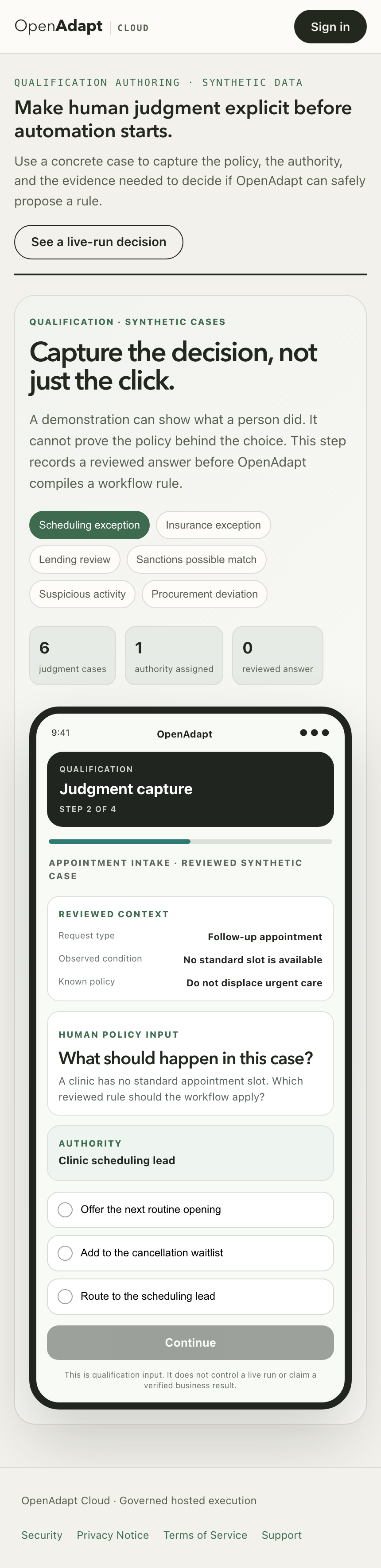
The qualification review must preserve the distinction between these three outcomes:
| Review result | Meaning | What the certified workflow does |
|---|---|---|
| Automatic rule candidate | The examples and counterfactuals support a repeatable rule with checkable facts. | Qualify the rule and its evidence checks. The rule still needs the normal certification tests. |
| Human decision node | The choice remains a valid human policy choice. | Keep the finite options and role requirement in the graph. |
| More evidence required | The cases do not identify a stable rule or a safe finite choice. | Request more examples or leave this part for a human. Do not infer a policy. |
Do not learn a production rule from one answer. A later review can promote a rule candidate only by creating a new qualified workflow revision.
What a reviewed decision contains
A decision contract includes:
- a static, reviewed question;
- two or more reviewed finite options;
- a permitted role or roles;
- an exact successor for every option;
- expiry and one-use scope;
- decision provenance: the workflow version, reviewer, policy source, and qualification revision; and
- the required state, identity, target, postcondition, and effect checks after the answer.
The task has no GUI action. It pauses before the next branch. A repair cannot alter the option set or route around the node. A change to the question, options, roles, or branches requires a new qualification revision.
The exact wording is reviewed workflow content. OpenAdapt does not create it from screenshots, OCR, application names, input values, or a model during a production run.
Example: exception routing
An operations workflow receives a record that qualifies for either the normal route or an approved exception. The qualified decision can ask:
Which reviewed route applies to this item?
- Priority review
- Standard review
- Supervisor
The exact record identity remains on the customer-controlled runner. The question does not ask the person to identify a record from a vague screen. The runner checks the required record identity again before any later write.
What happens after the person answers
The mobile or desktop surface shows one request, its reviewed context, and only the options that the contract permits. It cannot add a new option or free-text instruction.
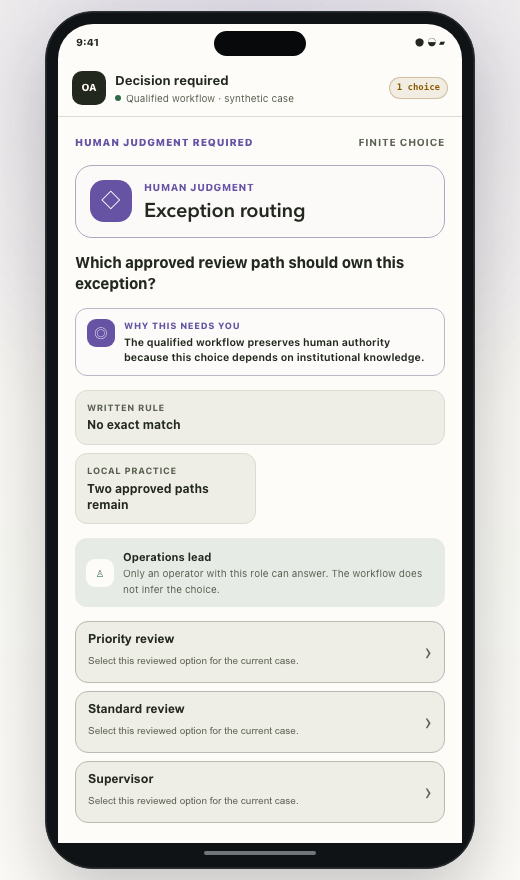
- The route authenticates the person and verifies their permitted role.
- It submits one signed option with an idempotency key.
- The runner validates the task, policy, presentation, role, option, expiry, and one-use binding.
- The runner records a signed answer receipt.
- The runner obtains a fresh settled observation and runs the selected branch's live-state checks.
- The runner follows only the successor for that option.
- Each later consequential action still requires target resolution, identity, postcondition, and effect verification.
If the application state changed, the task expired, the role is wrong, or the answer was already used, the runner refuses the transition. It does not apply a second answer. It does not replay a possibly consequential action without the required checks.
The answer proves only this: an authorized person selected one reviewed option
for one task. It does not prove that an application changed. Only the terminal
execution receipt can report VERIFIED, and only after the configured effect
evidence passes.
Data boundary
Raw examples, captured screens, OCR, identifiers, and full decision evidence stay in the customer-controlled environment by default. A remote route receives an opaque task binding and a reviewed presentation. The task carries identifiers, digests, expiry, permitted option IDs, and closed status values. The reviewed presentation carries the static question and labels that the operator may read.
The remote route does not receive raw cases or screen content. If a person must inspect protected live evidence to make the choice, use the runner-local operator surface or a customer-controlled delivery route.
The screenshots on this page come from accepted synthetic Cloud demo sources. They show the two separate product surfaces. This page uses the retained, versioned captures rather than depending on a public demo route.
Related documentation
- Attend a paused run and teach a correction for a runtime safety halt.
- Qualify a workflow for certification and versioning and the Desktop qualification cockpit.
- Workflow IR for graph nodes and controlled branches.
- Run outcomes and halt reasons for
decision_requiredand terminal receipts. - OpenAdapt Types for the portable task and answer-receipt schemas.
- OpenAdapt Flow for the local runtime that validates the decision contract and performs the later revalidation.