OpenAdapt Execute: private-pilot guide
OpenAdapt Execute gives a software or service provider a safe way to complete an authorized transaction in an application that the provider cannot directly integrate with.
Your product decides the business action. OpenAdapt executes the qualified
transaction in the customer-controlled browser, desktop, RDP, Citrix, or API
environment. It then returns a Seal: ExecuteEvidenceReceiptV1. Unsigned
success is failure.
authorized transaction
  -> qualified local execution
  -> effect verification
  -> Seal (verified | halt | reconciliation_required)
The one CLI story:
A sealed verified run prints VERIFIED, a seal id, and
https://openadapt.ai/seals/{id}. That route is synthetic and non-PHI only.
--seal on replay is the intended Seal command. openadapt flow seal
encrypts a bundle for deployment.
Private pilot. Not a public API.
This page describes the private-pilot product contract. It is not an
self-service integration recipe and it does not publish partner access,
credentials, an SDK, or a webhook URL. openadapt-types 0.9.0 publishes
the shared async Execute schema, OpenAPI document, and signed decision
contract. OpenAdapt Cloud provides private execution, customer-runner
coordination, and receipt delivery for approved pilot partners.
What a partner gets
OpenAdapt starts with one named transaction in one customer environment. For example: create a follow-up appointment, submit a claim correction, update a loan application, or post a reconciled record.
The qualification work produces:
- a reviewed workflow and parameter contract;
- a named application, version, environment, and runner boundary;
- identity checks for each consequential action;
- a declared effect and the required evidence strength;
- an idempotency rule and an uncertain-delivery rule;
- representative and fault cases;
- a sealed qualified version and an acceptance report.
The partner can then submit an authorized transaction to the private pilot service. The service selects only the exact qualified workflow and the exact customer-controlled runner that can meet the contract.
The Execute contract
The production surface is asynchronous. A transaction can wait for a person, wait for reconciliation, or resume after a runner restart. A caller receives an execution identifier and observes state changes. It does not wait for a GUI session in one HTTP request.
ExecuteRequestV1
Each ExecuteRequestV1 contains exactly these public fields:
schema_version: openadapt.execute-request/v1;qualification_id;workflow_versionandworkflow_digest;environment_id;- typed
parameters; idempotency_key;authorization_contextwithactor_idandauthorization_reference;effect_strength_schema_version; andminimum_effect_strength.
The same idempotency key with the same request returns the existing execution. A changed request under that key is refused. OpenAdapt also keeps an effect-aware record of delivery, so it does not repeat a write after an uncertain result.
Internal qualification and runtime binding
The qualification and runtime hold additional controls outside
ExecuteRequestV1. They bind the approved workflow to its sealed bundle,
policy, runner capability set, and customer environment. The runner also
checks the locally issued authority and its exact delivery and input binding
before it acts. These controls protect the execution path; they are not caller
fields in the public Execute request.
Lifecycle states
The private-pilot contract uses these states. A state describes current work; it is not a success claim.
| State | Meaning |
|---|---|
queued |
OpenAdapt accepted the request for dispatch. |
running |
The runner is observing, resolving, acting, or verifying. |
decision_required |
A bounded attended question needs an authorized person. |
waiting_for_reconciliation |
A possible or conflicting effect needs a live read before OpenAdapt can continue. |
terminal |
The execution has one final transaction outcome and a receipt. |
Terminal transaction outcomes
The released OpenAdapt Execute v1 contract defines these outcomes. The private-pilot service exposes the same values without translating them into a generic "success" flag.
| Outcome | Meaning for the partner |
|---|---|
verified |
The configured authorization, identity, postcondition, and effect contracts passed. |
halted_before_effect |
OpenAdapt stopped and evidence established that no consequential effect occurred. |
reconciliation_required |
Delivery, persistence, or the observed effect is uncertain or conflicting. Do not submit the write again. Reconcile first. |
failed_platform |
A platform failure occurred before any possible business effect. |
rejected_policy |
Qualification, authorization, identity, environment, or policy refused the transaction before effect. |
rolled_back_verified |
A configured compensating action completed and the receipt includes verification evidence for that compensating effect. |
verified is the business-success outcome. rolled_back_verified proves the
configured compensating effect, not the original requested effect.
Customer-controlled execution
The runner stays in the agreed customer boundary. This can be a workstation, a customer-managed VM, a VDI client, or a dedicated browser runner.
The runner validates the exact authorization locally before it acts. The control plane cannot substitute the bundle, widen the policy, or reuse an authorization for a different input. Sensitive screen content and live entity identifiers stay in that boundary unless the customer explicitly configures a different evidence path.
OpenAdapt uses a qualification-owned entity class only as static presentation
metadata. A task may say patient record, insurance claim, or loan
application when its certified contract declares that class. A remote surface
does not infer a class or an identity from a screenshot, OCR, an application
name, parameters, or a model. If the class is unavailable, it uses record or
item. The runner rechecks the real identity before any resumed action.
Attended and unattended operation
The private pilot runs attended. A person is signed in to the target
application, and the runner acts inside that session. A consequential write
pauses at decision_required until an authorized person answers, and the
runner rechecks live identity and workflow state before it continues. The
attended decisions section below
describes that round trip.
That person stays the legal actor. A Seal records that the configured authorization, identity, postcondition, and effect contracts passed for one run. A Seal is not a physician signature.
Unattended operation is qualified separately and is not part of the private pilot. It requires a dedicated agent identity, privileged access management, and session recording. In either mode, OpenAdapt does not type a person's password, reuse a person's login, or share a service account.
Oracle tiers
Only a tier 2 or tier 3 oracle mints a production Seal.
| Tier | What it reads | Production Seal |
|---|---|---|
| 0 | Visual / OCR | Never. Dev only. |
| 1 | Second session or independent UI read | Never. |
| 2 | System-of-record read (API, database, file, ack) | Yes. |
| 3 | Counterparty artifact (payer status, legal export) | Yes. |
The field map, requires_seal, and Copilot coexistence live on
The Seal.
Attended decisions and mobile delivery
When the runner cannot prove a required condition, it creates one signed, bounded operational decision task. The operator can answer from the local console or the authenticated phone/web decision surface. The hosted lane receives a closed-schema context without screenshots or protected fields. The runner-local portal can show detailed retained evidence inside the customer boundary.
An operator answer is not a command to repeat a write. The runner first reacquires focus, a fresh observation, the workflow state, identity evidence, and the target. It continues only if those checks pass. The resulting Seal binds the decision, the runner transition, and the final state to the exact task and authorization.
These three images show the runner-local, full-evidence portal with synthetic OpenEMR data. The hosted lane uses the same signed actions and transition states, but it does not receive these screenshots.
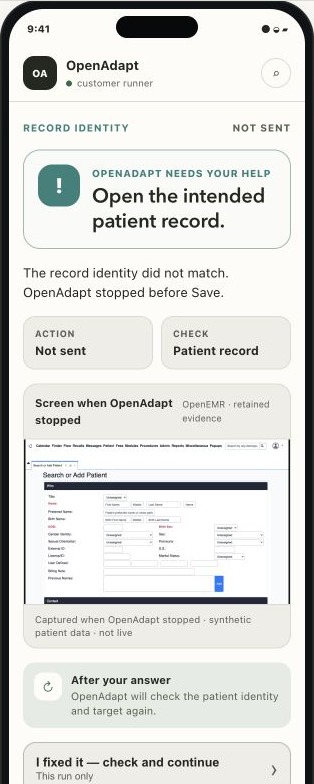
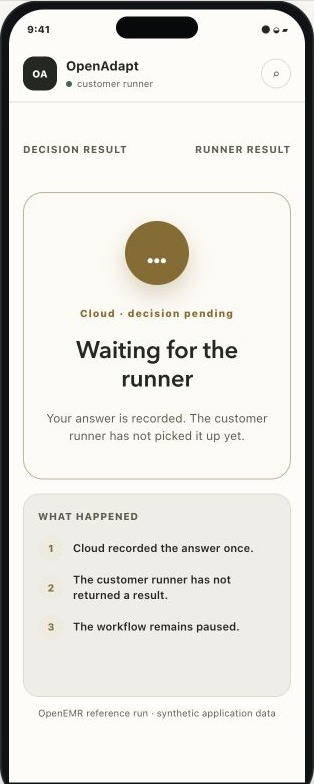
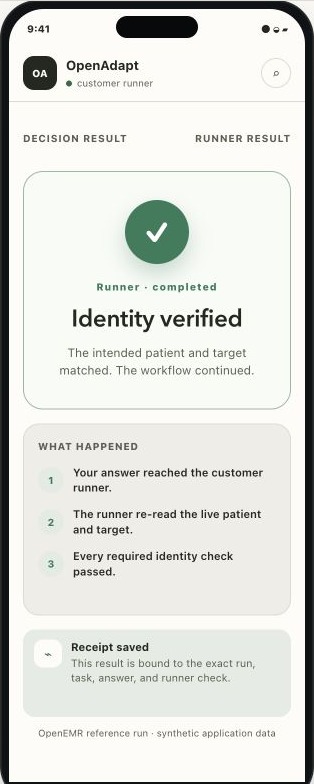
Try all six synthetic decision types or review the full attended-decision contract.
The released public contract for this round trip is
openadapt-types 0.9.0. It defines the async Execute schema and OpenAPI
document, plus signed, PHI-safe decision tasks and receipts. Flow and Cloud use
this contract for the decision relay and private-pilot execution. The partner
event stream does not contain raw screenshots or live record data.
Receipts and partner integration
ExecuteEvidenceReceiptV1 is the Seal
Every terminal execution returns an ExecuteEvidenceReceiptV1. That object is
the Seal. Map the receipt fields 1:1.
| Receipt field | Seal field |
|---|---|
receipt_id |
Seal id. Verify at https://openadapt.ai/seals/{receipt_id} (synthetic only). |
execution_id |
The POST /v1/executions that produced this Seal |
workflow_digest, workflow_version |
Admitted program |
qualification_id, environment_id, runner_id, nonce |
Admission, environment, runner, uniqueness |
oracle_tier |
0 visual, 1 second-session, 2 system of record, 3 counterparty |
outcome |
verified / halt / reconciliation_required / the other terminal values |
contracts |
Authorization, identity, postcondition, effect |
evidence_digest |
Pointer to retained evidence. Bytes stay in the boundary. |
issued_at |
When the Seal was issued |
verified requires oracle_tier 2 or 3. HTTP 202 is not a Seal. The status
resource supplies evidence_receipt_id only when its state is terminal.
Consequential MCP tools advertise requires_seal: true. If the tool returns
unsigned success, treat it as failure.
Local and private evidence
The customer-controlled runner retains richer evidence outside
ExecuteEvidenceReceiptV1. This can include the exact bundle and input
bindings, runner and environment details, report bodies, screenshots, live
identity checks, and application observations. The public receipt identifies
that evidence by digest. It does not copy it into the partner event stream.
The partner stores the Seal with its own transaction record. That is what you show an end customer. A screenshot or a UI banner is not proof.
Private-pilot integrations use signed, versioned webhook events and polling. Webhook retry, signature verification, ordering, and event deduplication are part of the Execute contract. The Execute integration guide shows the request, status, Seal, and webhook flow. The field map lives on The Seal.
Start with one workflow
The first step is a Workflow Qualification Sprint, not broad platform integration. Bring one repeated transaction, the actual target application and environment, a verifier path, and the operator who handles exceptions.
The sprint gives both teams a qualified transaction, a measured acceptance campaign, and a clear reuse decision. If the same transaction can transfer to additional customer environments, OpenAdapt and the partner turn it into a commercial compatibility pack.
Product boundary
| Layer | Availability | Role |
|---|---|---|
| OpenAdapt Flow | MIT-licensed | Local compiler, governed runtime, halt/teach, qualification tools. Compile-once is a cache. |
openadapt-types |
MIT-licensed | Shared Execute schema. The evidence receipt is the Seal. |
| OpenAdapt Cloud foundation | Private and deployed | Tenant control plane, customer-runner coordination, signed decision relay. |
| OpenAdapt Execute | Private pilot | POST /v1/executions issues Seals. Not a new repository. |
| Compatibility packs and verifier recipes | Commercial | Per-application and per-environment qualification assets. Bundles are not liquid. |
Next step
Bring one system, one transaction, and one measurable business result. We will define the execution and evidence contract together.